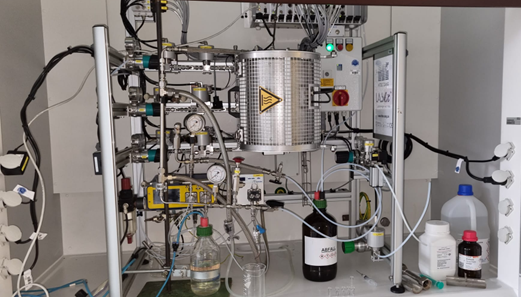
In collaboration with the Cologne University of Applied Sciences, we developed a fixed-bed reactor that was used to investigate the long-term stability of various catalysts. The paper resulting from the study and the associated experiments was published in the International Journal of Molecular Sciences.
As part of the experiments, the potential of robust, strongly basic Type I ion-exchange resins as catalysts for the aldol condensation of citral and acetone was investigated. The aldol reaction in particular—which is traditionally carried out using aqueous sodium hydroxide as a catalyst—holds the potential for greater sustainability and reduced waste production. In several batch experiments, different deactivation processes of the catalysts were observed based on the temperature profile.
Continuous operation in a fixed-bed reactor with temperature course of (a) citral and acetone (1:8) with 2 mL/min and an effective catalyst volume of 11.5 mL Amberlyst® A26 OH catalyst at 30 °C and (b) citral and acetone (1:8) with 2 mL/min and an effective catalyst volume of 11.5 mL Lewatit® K 6465 catalyst at 30 °C.
In addition, the system was used extensively during the lab practicum. Thanks to its intuitive interface, the students found it very easy to use the accompanying automation software LabVision This provided the lab technicians with a unique opportunity to work with a system that is rarely encountered in typical day-to-day laboratory work.
We are pleased that our technology is helping to advance research and enable important study results. If you have a research project where we can support you, please feel free to contact us. And if you’d like to delve deeper into the exciting findings from the Technical University of Cologne, you can find the online paper here:
From Research
Temperature Stable Ion Exchange Resins as Catalysts for the Manufacturing of Vitamin Precursors by Aldol Reaction
Jonas Vosberg, Thomas Bouveyron et al. • International Journal of Molecular Sciences • 2023
Thank you very much! We have received your data and will usually contact you personally within the next three working days – regardless of whether it concerns a specific project, a quote, or an initial consultation.