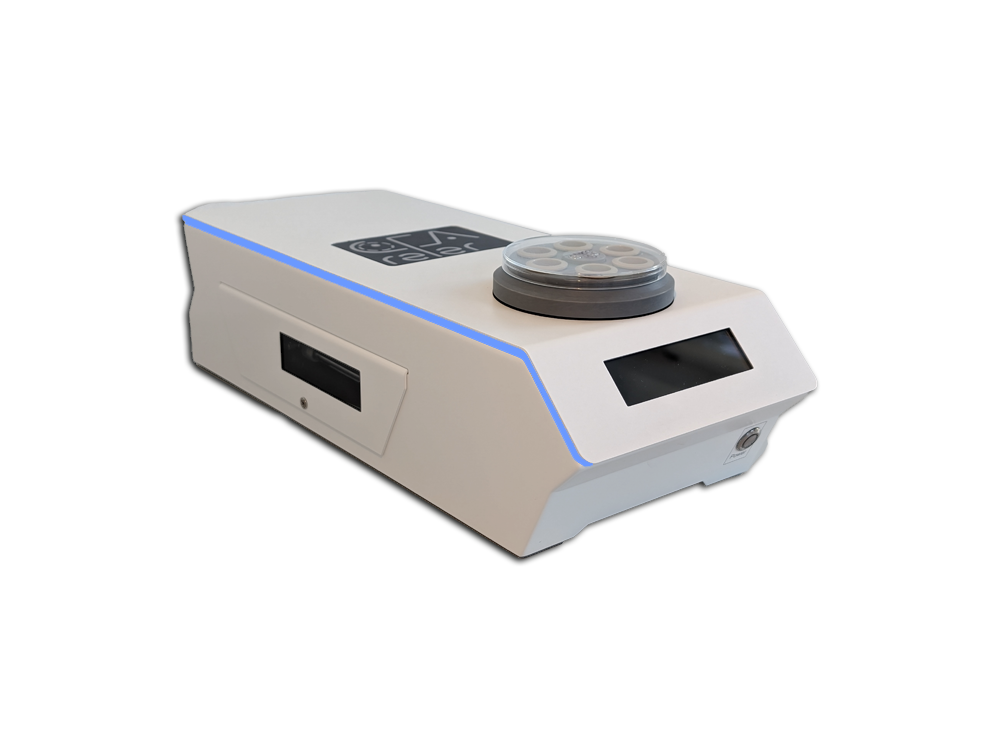
Cell culture applications under flow conditions place high demands on the control of environmental conditions, imaging, and reproducibility. PatchFlux AI™ is a microfluidic system specifically developed to precisely analyze cells under defined flow conditions. Researchers can accurately control shear stress, temperature, pH, and media exchange, enabling realistic simulation of physiological or pathological conditions.
The platform is suitable for applications in cell biology, hematology, and pharmacology. A glass-covered observation platform enables high-resolution imaging of cells in the flow channel. For specialized applications, the system can also be configured for patch-clamp measurements under flow conditions.
PatchFlux AI was developed for research questions where controlled environmental conditions, low sample volumes, and real-time quantitative analysis are essential. The system supports experiments with red and white blood cells, endothelial cell models, and single cells in microfluidic setups.
Thanks to the integrated high-precision thermostat, the temperature remains stable even during long-term experiments. Shear profiles, exposure duration, and media exchange can all be set via software control and reproduced consistently. This makes PatchFlux AI especially suitable for studies on:
Discover the PatchFlux AI modules and find the right configuration for your research.
Contact us for a product demo, technical details, or an application-specific consultation.


The PatchFlux AI hardware forms the core system. Additional functions are added through separately available software modules. This allows you to start with a basic system and tailor the platform specifically to your research projects.
1. RBC Mechanics – Mechanical Properties and Deformability of Red Blood Cells
Quantify elongation, stiffness, and relaxation of erythrocytes under controlled shear stress. The module supports research into diseases and conditions such as:
2. Osmotic Fragility – Real-Time Osmotic Fragility
Generate osmotic or fragility curves in real time using the smallest blood volumes. The AI-supported analysis automatically calculates the MCF50 value. Suitable for:
3. Cell Adhesion – Cell Adhesion under Physiological Flow
Analyze the adhesion of erythrocytes and leukocytes to endothelial cells under defined flow, temperature, and media conditions. The module is suitable for modeling vascular and inflammatory processes as well as for high-throughput AI-supported image analysis.
4. RBC Shape & Aggregation – Shape Analysis and Rouleaux Formation
Detect and classify erythrocyte morphology, aggregation dynamics, and cell subpopulations using artificial intelligence. This is particularly relevant for:
5. Patch-Clamp under Flow
Measure ion channel activity at the single-cell or cell-cluster level while cells are exposed to defined temperature, pH, osmolarity, and drug conditions. Controlled solution exchange takes place without disturbing the patch unnecessarily.
6. AI-Supported Workflow for Sickle Cell Disease and Thalassemia
A dedicated workflow for research into clinically relevant erythrocyte phenotypes in sickle cell disease and thalassemia is currently in active development and will be available on request.
We support you not only with the hardware, but also with practical assistance — from the initial consultation to applications, experimental setups, and implementation.
Are you a researcher in hematology or cell biology? PatchFlux AI offers precise microfluidics with AI analysis for erythrocytes, adhesion, and patch-clamp.
Contact us today for a free consultation.
| Microscope slide | Microscope slide according to DIN ISO 8037-1 Glass or polymer; custom design/coating available on request |
| Flow channel height | 0.3 mm |
| Chamber width | 14 mm |
| Chamber length | 55 mm |
| Wall shear stress | 0.25 – 10 Pa |
| Shear-flow shutoff time | 0.3 ms |
| Solution exchange time | 2.0 s at 0.25 Pa shear stress |
| Dimensions (W x H x D) | 78 x 27 x 121 mm |
| Material | Titanium or stainless steel (AISI 316L / EN 1.4404) |
| Seals | Silicone (FDA) and EPDM |
| Temperature control | Water-circulation thermostat |
| Temperature accuracy | ± 0.1 °C |
| Hot-water outlet | Tubing connection, 6 mm inner diameter, 8 mm outer diameter |
| Temperature sensor | Pt1000 rod probe, 1.5 x 100 mm, LEMO 1S |
| Pneumatic seals | 2x FESTO QSRL-M5-4 |
With PatchFlux AI, the deformability of red blood cells can be measured by image analysis in a precisely controlled microfluidic environment. The system enables control of flow rate, shear stress, temperature, and media conditions, allowing cell deformation, stiffness, and relaxation behavior to be determined under physiologically relevant conditions using quantitative AI-based image analysis.
PatchFlux AI is suitable for osmotic fragility tests with very small sample volumes, including low blood volumes. Controlled solution exchange and AI-supported evaluation allow fragility curves to be generated in real time and parameters such as the MCF50 value to be determined automatically.
With PatchFlux AI, the adhesion of erythrocytes or leukocytes to endothelial cell monolayers can be investigated under defined flow conditions. The platform combines adjustable shear stress, temperature control, and high-resolution imaging, supporting quantitative analysis of cell adhesion under realistic conditions.
PatchFlux AI enables real-time analysis of erythrocyte shape, rouleaux formation, and aggregation dynamics in a controlled flow environment. In combination with the appropriate software modules, the system supports AI-based classification of morphologies and cell subpopulations for research, screening, and phenotyping.
PatchFlux AI was designed to enable patch-clamp measurements under controlled flow conditions. After removing the glass cover, researchers have direct access to the electrodes from above. Meanwhile, temperature, pH, osmolarity, and solution exchange can be controlled consistently and reliably.
Thank you very much! We have received your data and will usually contact you personally within the next three working days – regardless of whether it concerns a specific project, a quote, or an initial consultation.