
Hydrometallurgy
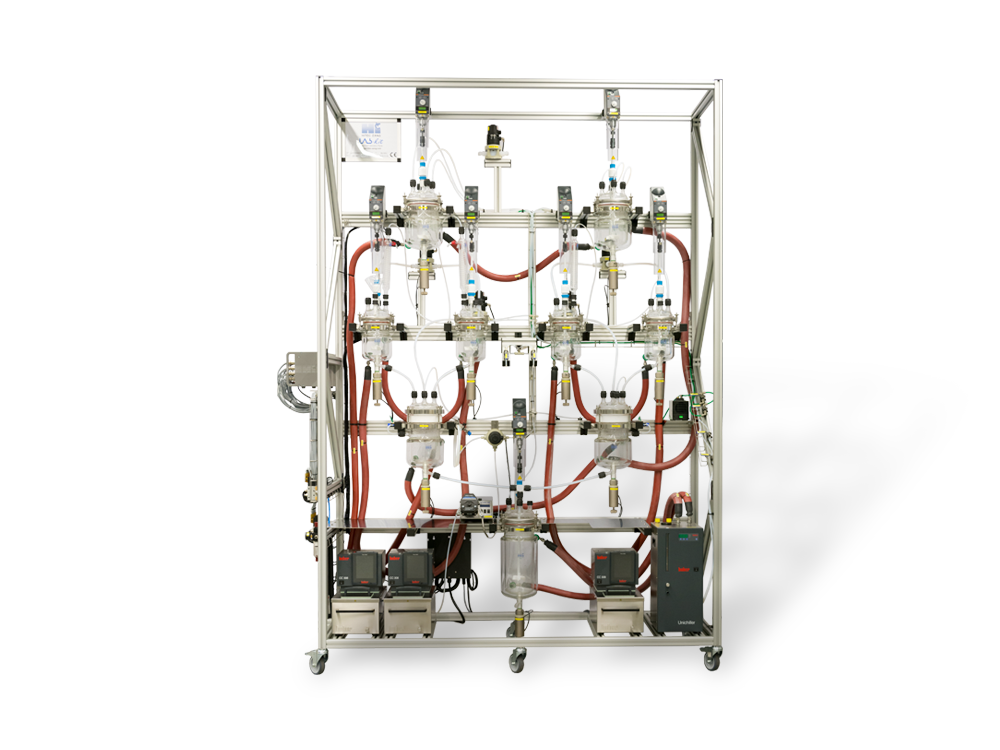
Automated Hydrometallurgical Processes
Laboratory and Pilot-Scale Systems for Leaching, Solvent Extraction, and Electrolysis
Hydrometallurgical processes require precise control of temperature, pH, and residence time. Even small deviations can affect yield and purity. HITEC ZANG develops customized laboratory and pilot-scale systemsthat are fully automated, process-safe, and ready for scale-up.
Hydrometallurgical processes operate at lower temperatures than pyrometallurgy and emit fewer gases. Energy consumption is 30 to 50% lower than that of smelting processes. However, these processes require more water, and the use of acids and solvents necessitates careful wastewater treatment. Automation does not solve these challenges. However, it provides the data needed to measure consumption and reduce it in a targeted manner.
What Is Hydrometallurgy?
Hydrometallurgy encompasses wet chemical processes for the extraction, refining, and recycling of metals from ores, concentrates, and secondary raw materials. In contrast to pyrometallurgy, which operates at temperatures between 800 and 1,500 °C, hydrometallurgical processes take place at room temperature or at moderately elevated temperatures. This enables a high degree of selectivity in metal separation and the direct production of high-purity metals, such as electrolytically produced copper with a purity of 99.99%.
Typical process steps include leaching with sulfuric acid, hydrochloric acid, or ammonia, followed by solid-liquid separation, solvent extraction, ion exchange, membrane processes, and electrolysis. Applications range from the extraction of primary raw materials such as copper, nickel, cobalt, lithium, and rare earth elements to the recovery of metals from secondary raw materials, including black mass from lithium-ion batteries.
Standard Process Flow
Hydrometallurgical process chains follow a clearly structured sequence. HITEC ZANG can implement the complete process, from the initial laboratory stage through to a pilot plant.
1. Leaching
- Dissolving metal ions in an aqueous acid or alkaline solution
- Processing under atmospheric pressure or elevated pressure
2. Solid-Liquid Separation
- Filtration
- Centrifugation or thickening to separate the gangue material
3. Selective Separation
- Solvent extraktion
- Ion exchange or membrane processes for selective metal separation
4. Metal Recovery
- Electrolysis
- Precipitation or cementation to recover the pure metal
Hydrometallurgical Subprocesses
HITEC ZANG develops fully automated laboratory and pilot-scale systems for all key stages of hydrometallurgical process chains - from individual subprocesses to integrated pilot plants.
Leaching
Metal ions are dissolved from ores, concentrates, or secondary raw materials using acids, alkaline solutions, or ammonia compounds. Processes can be carried out under atmospheric pressure or elevated pressure.
Solvent extraktion
Metal ions are selectively transferred from an aqueous phase into an organic phase to purify solutions and separate mixtures of metals.
Precipitation and Cementation
Metals are selectively precipitated by adjusting the pH, adding reducing agents, or using cementation reactions on metallic surfaces.
Ion Exchange
Metal ions are selectively adsorbed onto and desorbed from ion-exchange resins. This process is particularly suitable for dilute solutions and trace metals.
Electrolysis
Pure metals are electrochemically deposited from a solution. Purity levels of up to 99.99 % can be achieved - for example, in the production of electrolytic copper.
Membrane Processes
Metal ions are separated and concentrated using ultrafiltration, nanofiltration, electrodialysis, or diffusion dialysis.
Benefits of Automated Laboratory and Pilot-Scale Systems
HITEC ZANG’s automated hydrometallurgical systems enable unattended long-term experiments, seamless measurement data acquisition, and high reproducibility. This forms the basis for valid research results and a safe scale-up to production scale.
- Reproducibility: Precise parameter control ensures comparable results across all experimental runs.
- Process reliability: Critical measurements are monitored in real time, with automatic safety shutdowns when required.
- Efficiency: Unattended 24/7 operation allows more experimental runs to be completed in less time.
- Documentation: All process parameters and measurement data are recorded continuously in compliance with Good Laboratory Practice requirements.
- Resource efficiency: Precise pH and dosing control prevents overdosing of reagents. This measurably reduces consumption.
Typical Fields of Application
HITEC ZANG supports research institutions and industrial companies in the following areas:
Battery Recycling
Recovery of lithium, cobalt, nickel, and manganese from the black mass of lithium-ion batteries.
Metal Recovery
Recovery of copper, zinc, nickel, and cobalt from primary and secondary raw materials.
Critical Raw Materials
Seltene Erden, Platingruppenmetalle, Lithium aus Primär- und Sekundärquellen
Circular Economy
Urban mining, electronic-waste processing, and solvent recovery.
From Research
HITEC ZANG reactor systems are used internationally in scientific research. In a study by KU Leuven (Belgium) published in 2022 in the Journal of Sustainable Metallurgy a custom-built 1-liter glass reactor from HITEC ZANG was used for scale-up experiments on the purification of lithium chloride to battery-grade quality - a process in the field of sustainable metallurgy and battery recycling.
One-Step Solvometallurgical Process for Purification of Lithium Chloride to Battery Grade
Dženita Avdibegović et al. · Journal of Sustainable Metallurgy · 2022


Talk to our project engineers. We'll analyze your requirements and work with you to develop the right solution.
Questions & Answers
There is no one-size-fits-all answer to this question. It depends on the point of comparison. Compared to pyrometallurgy, hydrometallurgy has clear advantages: lower gas emissions, no high-temperature smelting at 800 to 1,500 °C, and 30 to 50% lower energy consumption. On the other hand, water consumption is higher, and the use of acids, alkalis, and organic solvents requires extensive wastewater treatment. Whether a specific process is more sustainable overall depends on the method, the quality of the raw materials, and the operating procedures—as well as on how consistently water and acid cycles are closed.
Yes. In addition to developing new systems, HITEC ZANG offers the retrofitting and automation of existing equipment.
This can include the integration of sensors for pH, redox potential, temperature, flow rate, and turbidity, the installation of a programmable logic controller, the connection to process control software, and the implementation of Good Laboratory Practice-compliant measurement-data documentation.
This makes it possible to upgrade established laboratory infrastructures to automated experimental operation without replacing the entire system.
Yes. Battery Recycling- particularly the processing of black mass from lithium-ion batteries - is one of the principal applications of hydrometallurgical laboratory and pilot-scale systems.
Hydrometallurgical processing is particularly suitable for this purpose because it enables the highly selective separation of lithium, cobalt, nickel, and manganese. It can also produce high-purity fractions directly within the process.
HITEC ZANG systems are designed to resist corrosion and are suitable for use with aggressive media such as acids, alkaline solutions, and organic extraction agents.
When scaling up from the laboratory to the pilot plant scale, results often vary when control and sensor systems differ between plant sizes. HITEC ZANG therefore relies on a uniform control and sensor architecture across all plant sizes. The process parameters validated in the laboratory—namely pH, temperature, agitator speed, and dosing rates—are directly carried over to the pilot plant. This minimizes transfer errors and makes laboratory results directly scalable. Upon request, our engineers can also assist with the design of the pilot plant based on your laboratory data.
HITEC ZANG develops automated pilot plants for all key subprocesses: leaching (atmospheric, pressurized, using sulfuric acid, hydrochloric acid, or ammonia), solid-liquid separation, solvent extraction (mixer-settler systems), ion exchange, membrane processes (ultrafiltration, nanofiltration, electrodialysis), as well as electrolysis and precipitation. The systems have a modular design and can be combined to form complete process chains, ranging from a single reactor to an integrated pilot plant.
Hydrometallurgy, leaching, solvo-leaching, precipitation, and lithium recovery are particularly relevant topics.
The volume of used batteries—especially from electric vehicles—will surge starting around 2030,when the first generations of mass-market EVs reach the end of their useful lives. Recycling facilities must be able to handle this growing volume without costs and quality spiraling out of control
Automation makes this possible—manual processes, on the other hand, quickly reach their limits.
Black mass is a key feedstock in battery recycling, from which valuable raw materials can be recovered through appropriate processing steps.
The composition and quality of black mass vary greatly depending on the battery manufacturer, cell chemistry, and age of the battery. This makes automated analysis and sorting all the more important.
Many recycling processes are complex, sensitive, and highly dependent on specific parameters. Automation is the key to making battery recycling safe, reproducible, and cost-effective—and thus to enabling the circular economy for electric mobility, for example.