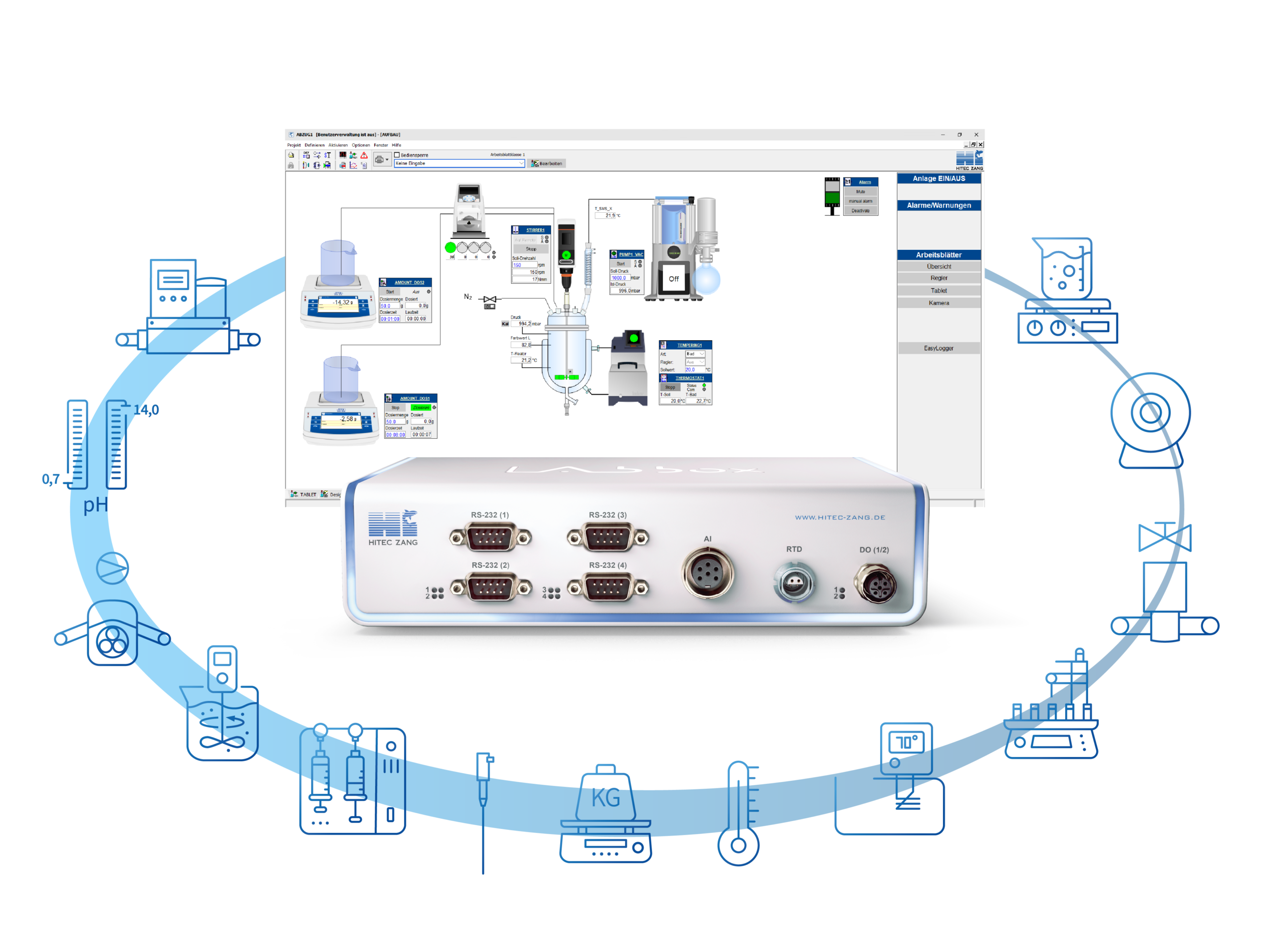
LabVision Software
Control. Regulate. Monitor
Modular Automation and Process Control Software
With LabVision®, you can reliably control and scale your reactor systems in the laboratory, pilot plant, and mini-plant. Applications range from micro- and laboratory-scale systems starting at 10 milliliters, through standard laboratory reactors with capacities from 250 milliliters to 5 liters, all the way up to pilot plants with capacities of 100 liters and beyond.
The system scales with your test setup, from a single measurement point to a networked process control system with up to 5,000 I/Os.
Challenges in the Laboratory & Pilot Plant
Initial Situation
Whether in chemical process development, in regulated formulation processes in the pharmaceutical industry, in fermentation processes in biotechnology or in processing for battery and plastic recycling, commercial process control systems designed for large-scale industrial applications are oversized for small, frequently changing experimental setups. In-house developments based on LabVIEW or PLCs tie up development resources.
LabVision bridges this gap with off-the-shelf software that can be customized in a modular fashion to fit any experimental setup, requires no programming, and offers the flexibility of a custom solution.
Typical challenges
- Critical experiments require constant supervision, often even outside of working hours.
- Manual process management and incomplete documentation make it difficult to ensure traceability.
- Routine tasks take up valuable time that could otherwise be spent on research.
- Rigid systems and incompatible interfaces hinder growth and adaptation.
Our solutions
- Safety: Monitor experiments 24/7, even remotely.
- Reproducibility: Automated processes and complete test documentation.
- Efficiency: Less time spent on routine tasks, more time for research.
- Scalability: Flexible software modules and standardized interfaces.
LabVision-Basismodul - die Kernfunktionen
The foundation of every LabVision installation
- 10 i/Os*: From individual measurements to networked multi-device systems.
- A PID controller*: Precise process control for every reaction.
- Integrated designer: Create your own process flowcharts without any programming knowledge.
- Alarm Management: Automatically monitor critical process limits.
- Multi-plotter system: Graphical recording of the trends of multiple parameters.
- Process report: Complete, automated documentation of every test run.
- Project Modules: Create pre-configured device modules using drag and drop.
- Standardised interfaces: OPC UA, LADS, Modbus, Python, etc. for higher-level systems.
* Scalable to up to 5,000 I/Os and up to 64 PID controllers.
Modular System
Can be expanded as required
Would you like to automate your reactors cost-effectively? Record test data online? Control processes using digital recipes, or operate several plants simultaneously?
The LabVision Software is built up modularly and can be extended and upgraded to meet new requirements.
HITEXT
Control, monitor, and analyze using a scripting language.
HIBATCH
Graphically controlled, fully automated recipe processes – batch & continuous.
REPORT
Automated generation of professional experiment reports from process data.
REMOTE
Remote monitoring and control of experimental setups from outside the lab.
CPUPRO
AWL and AWL plus: data logging without a PC.
MULTILV
Running multiple LabVision instances in parallel.
FLOWCHEM
Controlling continuous flow processes (flow chemistry).
USERRIGHTS
Role-based access control and user management for regulated environments.
COMPACK
Interfaces to OPC UA, Python, LIMS, and more.
MULTIBATCH
Replicate and operate reactor systems in parallel.
KALDAS
Reaction calorimetry: heat flow and heat balance methods.
LabVision Basic Module
Core functions for measurement and control in the lab – the foundation of every LabVision system.
Expert Knowledge
What makes a good automation system for laboratories and pilot plants?
SCADA/DCS in large-scale industry vs. LabVision
Traditional SCADA and DCS systems are designed for continuous operation of large, static facilities. Reliable, but time-consuming to configure and cost-ineffective for changing experimental setups. LabVision applies the same principles (visualization, control, alarms, documentation) on a scale that can be configured in hours rather than weeks.
Scaling from the laboratory to the pilot plant
Many choose a solution that doesn't scale up with their operations. LabVision controls everything from a single stirrer to a networked system with 5,000 I/Os. Formulas and evaluation logic remain intact.
Why interface standards are crucial
Proprietary protocols turn a system into a silo. OPC-UA, Modbus, and a Python interface ensure that measurement data can be integrated into LIMS, ELN, or enterprise IT systems.
Areas of application:
HITEC ZANG supports research institutions and industrial companies in the following areas:
Technical Data
| I/Os | up to 5,000 |
| PID controllers | up to 64 |
| Interfaces | OPC UA, Modbus, Python, etc. |
Driver Library
| Supported thermostats | All models from Huber, Julabo, and Lauda with an RS-232 connection and all devices that use the ASCII or MODBUS protocol |
| Supported stirring systems | IKA, Heidolph, J-KEM, CAT with RS-232 connection and all devices that use the ASCII or MODBUS protocol |
| Syringe pumps | SyrDos, Cetoni |
| Peristaltic Pumps | LabDos, Ismatec, Fink |
| Balances | Mettler, Kern, Sartorius, Radwag |
| Vacuum Pumps | Vaccubrand |
| Flow controller | Bronkhorst, MKS |
LabVision contains a comprehensive driver library that can be expanded almost indefinitely to meet your specific needs.
What our customers say
From a management perspective, nights and weekends are always lost time. That's the simplest way to justify automation: you can let the equipment keep working during those hours.
Manuel Häußler
CSO aevoloop GmbH (a startup specializing in plastics recycling)
We can now set up automated laboratory tests within hours.
Dr.-Ing. Rafael Kuwertz
CEO Ehrfeld Mikrotechnik GmbH
We need high-quality, reproducible data. We want to carry out as few experiments as possible, but all the more precise for it.
Prof. Dr. Thorsten Röder
Mannheim University of Applied Sciences
Using statistical design of experiments, we develop at small scale, and then we can produce the required quantities for validation directly in the pilot plant.
Daniel Kommer
Polymer chemist in development
Questions & Answers
Yes, a comprehensive risk assessment in accordance with IEC 62443-3 is available for version 2025.12. This will help you securely integrate the software into your IT infrastructure and meet regulatory cybersecurity requirements.
For stable operation in regulated environments, we recommend the following minimum configuration:
Processor: Intel i3-13100 (3.4 GHz quad-core) or comparable AMD x64 processor
RAM: 16 GB DDR4 ECC RAM (for enhanced data security)
Hard drive: 1 TB SSD, divided into two partitions (system and data)
Interfaces: 2 LAN ports (separate ports for PNK and the company network), 2 RS-232 serial interfaces, 2 monitor ports
Operating system: Windows 11 Professional© (64-Bit)
Yes, the latest versions of LabVision are certified for Windows 11. Since the requirements for modern operating systems are constantly evolving, we have specifically expanded compatibility over the past few years:
Starting with version 2025.6, LabVision is officially QS-tested and certified for Windows 11. This is the recommended version for maximum stability.
Since version 2023.1, LabVision has been officially approved by its developers for use on Windows 11.
Earlier versions of LabVision were often developed for Windows XP or even older systems. These are generally no longer fully compatible with modern operating systems (Windows 10 and later).
Yes, HITEC ZANG has its own e-learning platform: HITEC Academy.
The video courses are designed for both beginners and advanced users and cover everything—from initial system setup and integrating sensors (temperature, pressure, flow) to creating complex HIBATCH recipes.
The courses are available free of charge after registration.